Movie review: “Ethan Frome”

The wanting never ends…


Movie review:

“Ethan Frome” (1993)


Liam Neeson, Patricia Arquette, Joan Allen

Director: John Madden

1 hr 39 mins

Based on the novel, Ethan Frome (1911), by Edith Wharton.


The breaking of a heart can take so long…

I watched the movie, then I read the book, then I watched the movie again (and again), it’s easier than reading the book again, but I’m going to do that too.

I think the book and the movie are interchangeable. Knowing the ending doesn’t reduce the dreadful intensity of this story that gets ever more sad from beginning to end.

Ethan Frome poster from IMDB

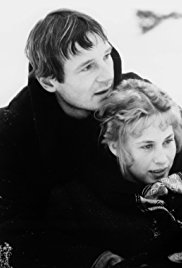
The deeply human love story breaks through the arid shell of real life—oh, so briefly…Ethan (Neeson) wants more, Mattie (Arquette) wants more, the viewer wants more…

Every other character in the story seems to, well, not necessarily “want” less, but to be all too righteously satisfied with less.

Except for a brief whirl of a crowded dance scene, there are no smiles on the faces of any of the other characters who live dried up lives, and disdain the spark of love and life in Ethan and Mattie.

Doubtless, the town folk see a pitiless moral lesson in the damaged life of Ethan Frome and the love he must keep stuffed inside him.

I see a man and a woman who share forbidden love, but don’t know what to do about it, and grotesquely fail to snuff it out.

*   *   *   *   *   *

Movie review. Copyright © Richard Carl Subber 2017 All rights reserved.

 
Seeing far: Selected poems with 47 free verse and haiku poems,
and the rest of my poetry books are for sale on Amazon (paperback and Kindle)
and free in Kindle Unlimited, search Amazon for “Richard Carl Subber”

Book review: The Sea Runners

…it informs, it does not soar…

by Ivan Doig

click here

*   *   *   *   *   *


Follow Rick on Facebook

Thoughtful book reviews by Rick Subber

Nothing Found

The poetic art of Grace Butcher

The poetic art of Grace Butcher

Find an audience,

     and read out loud…


Grace Butcher’s poems

   beg to be read aloud.


They are narrative and artful. She writes about familiar sights and experiences, and infuses them with exceptional imagery and insight.

Indeed, “the best words in the best order.” (I’m sure Coleridge doesn’t mind being quoted endlessly…)

Butcher has a delicate touch as she strokes the fabulous effulgence of her imagination, and explores her sensitivities to life and people around her.

These are worth your time:

Child, House, World

Hiram Poetry Review Supplement No. 12, 1991


Deer in the Mall

Self-published by Grace Butcher

*   *   *   *   *   *


Book review. Copyright © Richard Carl Subber 2017 All rights reserved.


My first name was rain: A dreamery of poems with 53 free verse and haiku poems,
and the rest of my poetry books are for sale on Amazon (paperback and Kindle)
and free in Kindle Unlimited, search Amazon for “Richard Carl Subber”

*   *   *   *   *   *

Follow Rick on Facebook

Thoughtful book reviews by Rick Subber

Nothing Found

Book review: Waterloo by Bernard Cornwell

Book review: Waterloo by Bernard Cornwell

Celebrity battle,

      butcher’s work

         on both sides…


Book review:

Waterloo


by Bernard Cornwell, New York: Penguin Books, c1987, 2001.

378 pages


This is my first read in Cornwell’s Richard Sharpe series. It’s both brilliant and deadening. Waterloo is a celebrity battle for most people, including me before I started Waterloo, and I guess most folks know little more than the outcome: Wellington and the Prussian commander, Blücher, put an end to Napoleon’s final fantastic comeback in Europe. The Little Corporal died six years later in exile.

Cornwell is an appealing storyteller and his exacting descriptions of characters, places and the battlefield milieu are almost a reward in themselves. It’s really impossible to feel detached from what’s going on. Ay, there’s the rub. I felt distress and then full-blown horror as the fighting wound up and then wound down—nearly 50,000 men were killed or wounded in frantically compressed combat that ended on June 18, 1815, in a small valley in Braine-l’Alleud near the Belgian town of Waterloo, which gave the epic battle its name.

Even the slightly Hollywood bravery of Richard Sharpe doesn’t soften the impact of reading about the butcher’s work done on all sides in that violent meeting of men and ambitions. The somewhat formulaic treatment of the lives and loves of key characters is a slight distraction, but it really doesn’t hinder the accelerating martial excitement of Waterloo.

Cornwell is a compelling storyteller. I was greatly moved by Waterloo, but I can’t say I’m glad I read it.

As usual, I offer my kind of book summary here. This is not a standard history book. The characters and plot are all too familiar. I offer my reflections about the author’s style and about the terrible horror of the decisive battle near a little town in Belgium.

*   *   *   *   *   *

Book review. Copyright © Richard Carl Subber 2017 All rights reserved.


Seeing far: Selected poems with 47 free verse and haiku poems,
and the rest of my poetry books are for sale on Amazon (paperback and Kindle)
and free in Kindle Unlimited, search Amazon for “Richard Carl Subber”

*   *   *   *   *   *

Book review: Great Tales of Terror and the Supernatural

Book review: Great Tales of Terror and the Supernatural

“The Rats in the Walls”…


Book review:

Great Tales of Terror

   and the Supernatural


Herbert A. Wise and Phyllis Fraser, eds.

The Modern Library, New York, 1944

1,080 pages


Indeed, these are great tales. The usual suspects are here: Poe, H. G. Wells, Lovecraft, Saki, Maupassant. A few tantalizing names are: Edith Wharton, Kipling, Hawthorne, Isak Dinesen…

My taste for horror and supernatural stuff is episodic, a little of it goes a long way for me. In that respect, this is a perfect volume—a reader can dip into it for a taste, then put it aside for a bit, and then go back for more.

Indeed, one reader’s horror is another reader’s trifle. Nevertheless, try reading “The Monkey’s Paw” again. Try reading “Leiningen versus the Ants” again (sure, you read it in middle school—it’s a different feel for a grown-up). Take a chance on O. Henry’s “The Furnished Room”—be prepared to be punched in the heart.

For my taste, Lovecraft’s “The Rats in the Walls” is the triumph of the genre. I first read it 50 years ago. Read it many times since. When I think about reading it again, I tremble.

*   *   *   *   *   *

Book review. Copyright © Richard Carl Subber 2017 All rights reserved.

many waters: more poems with 53 free verse poems,
and the rest of my poetry books are for sale on Amazon (paperback and Kindle)
and free in Kindle Unlimited, search Amazon for “Richard Carl Subber”

*   *   *   *   *   *

Follow Rick on Facebook

Thoughtful book reviews by Rick Subber

Nothing Found

Poets talk about poetry

Poets talk about poetry

…no fractured, disjoint,

       inchoate grab-bags

               of words…


“A poem…begins as a lump in the throat, a sense of wrong,

                                 a homesickness, a lovesickness…” 


Robert Lee Frost  (1874-1963)

in his 1916 letter to Louis Untermeyer (1885-1977)


Frost and Untermeyer exchanged letters (imagine!) for almost 50 years. I’m pretty sure every single one of them involved more than 140 characters and spaces…think about it, when you’re actually scribbling, you don’t have to “write” a space…

There are, I guess, about a million or so ways, more or less, to define “poetry.” In 1827 Samuel Taylor Coleridge (1772-1834) offered his “homely definition” of poetry: “the right words in the right order.” Sometimes I think poetry is the manifestation of lust for the right words.

I have this lust in my heart.

I am a poet, a writer, a teacher, a moralist, a historian, and an unflinching student of human nature. Some things I’d rather not know, but I’m stuck with knowing them. I think a lot. I strive to express truth and give context—both rational and emotional—to reality.

I think words can be pictures, and lovely songs, and bodacious scents, and private flavors, and early morning caresses that wake each part of me, one at a time. I know some of those words, and, from time to time, I write some of them.

Here’s a final thought for consideration: Coleridge also advised (1832) that “…if every verse is not poetry, it [should be], at least, good sense.” That makes good sense to me. I have no tolerance for some poets’ work that is merely a fractured, disjoint, inchoate grab-bag of words. A largely random collection of words is not likely to be a poem. I like to read (and write) a beginning, and an end, and some really meaty sweetie stuff in the middle.

Coleridge’s 1827 definition of poetry is from Specimens of the Table Talk of the late Samuel Taylor Coleridge, written by Henry Nelson Coleridge and published in 1835.

Louis Untermeyer was an American poet, anthologist, critic, and editor. He was appointed the 14th Consultant in Poetry to the Library of Congress in 1961.


For example, read The Poetry of Robert Frost, available on Amazon

*   *   *   *   *   *

My poetry. Copyright © Richard Carl Subber 2017 All rights reserved.

​​
My first name was rain: A dreamery of poems with 52 free verse and haiku poems,
and the rest of my poetry books are for sale on Amazon (paperback and Kindle)
and free in Kindle Unlimited, search Amazon for “Richard Carl Subber”

Book review: Shantung Compound

They didn’t care much

      about each other…

by Langdon Gilkey

click here

*   *   *   *   *   *

Pin It on Pinterest