
by Richard Subber | Jul 22, 2025 | Book reviews, Books, Human Nature, Joys of reading, Reflections
a lifelong quest…
Book review:
Atonement
by Ian McEwan (b1948)
New York: Nan A. Talese/Doubleday, 2001
351 pages
Atonement is a story of the profound sadness of a child. The sadness is a burden on several lives. McEwan invites the reader to learn to understand the life of a child who learns to understand that atonement can be a lifelong quest.
The child Briony knows she is a writer. She spends most of her life trying to understand how writing can be more than a fancy, and learning how to make it a substitute for real lives.
Briony, mature and nearing her own death, writes the final draft of her regrets for the childish impulse that unmade the lives of her beloved Cecilia and her beloved Robbie.
Briony learns that atonement can fill every space in a life, and she learns that atonement can be impotent.
* * * * * *
Copyright © Richard Carl Subber 2025 All rights reserved.
Book review: Shakespeare’s Wife
Germaine Greer went overboard a bit…
–
My first name was rain: A dreamery of poems with 53 free verse and haiku poems,
and the rest of my poetry books are for sale on Amazon (paperback and Kindle)
and free in Kindle Unlimited, search Amazon for “Richard Carl Subber”
* * * * * *

by Richard Subber | Jul 17, 2025 | American history, Book reviews, Books, Democracy, History, Language, Politics, Power and inequality, Reflections
“…to make lies sound truthful…”
Book review:
What Orwell Didn’t Know:
Propaganda and the New Face of American Politics
Andras Szanto, ed.
New York: Public Affairs, 2007.
236 pages.
This collection by Andras Szanto was published before the Obama presidency and what followed.
Essays by Martin Kaplan, Victor Navasky, and Geoffrey Cowan, in particular, illuminate these insightful, topical revelations about media failure to communicate truths.
George Orwell’s well-known essay, “Politics and the English Language,” is still useful and challenging, almost 75 years after he wrote it.
An excerpt from What Orwell Didn’t Know:
“…the present political chaos is connected with the decay of language…Political language…is designed to make lies sound truthful and murder respectable, and to give an appearance of solidity to pure wind…”
It is a terrifying reality that this statement sounds like it was written yesterday.
* * * * * *
Book review. Copyright © Richard Carl Subber 2025 All rights reserved.
Book review: The Bartender’s Tale
Ivan Doig’s story, I mostly loved it…
–
Writing Rainbows: Poems for Grown-Ups with 59 free verse and haiku poems,
and the rest of my poetry books are for sale on Amazon (paperback and Kindle)
and free in Kindle Unlimited, search Amazon for “Richard Carl Subber”
* * * * * *
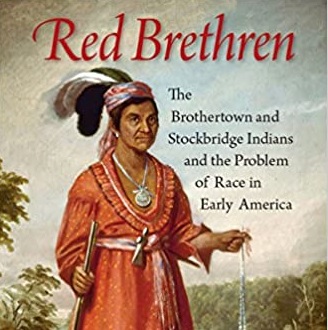
by Richard Subber | Jul 10, 2025 | American history, Book reviews, Books, History, Human Nature, Power and inequality
The Indians had a point of view…
Book review:
Red Brethren:
The Brothertown and Stockbridge Indians
and the Problem of Race in Early America
by David J. Silverman
Ithaca, NY: Cornell University Press, 2010
279 pages
Red Brethren is a scholarly deep dive into the experiences and mindsets of the First Americans who first tried to tolerate and later resisted the imperious impositions of the European colonists in North America.
The Indians left almost no record in their own writing, but Silverman exercises the customary technique of extrapolating Indian thoughts and attitudes from the written European record.
In the context of the widespread (not universal, still controversial) understanding that “race” is a social construct and a destructive concept, it is a bit puzzling that Silverman uses various manifestations of “race” in his analysis.
Nevertheless, he makes it plain that we have so much to learn about what the indigenous peoples thought of the European invaders, and how the thinking of our Red Brethren changed over time.
* * * * * *
Book review. Copyright © Richard Carl Subber 2025 All rights reserved.
Movie review: Same Time, Next Year
all-American adultery, oh yeah…
–
Seeing far: Selected poems with 47 free verse and haiku poems,
and the rest of my poetry books are for sale on Amazon (paperback and Kindle)
and free in Kindle Unlimited, search Amazon for “Richard Carl Subber”
* * * * * *

by Richard Subber | Jul 6, 2025 | Book reviews, Books
no fireworks here…
Book review:
The Awakening
and Selected Stories of Kate Chopin
by Kate Chopin (1850-1904)
Louisiana author
New York: Simon & Schuster Paperbacks, 2004
296 pages
There are no fireworks and little spark in Kate Chopin’s prose.
Her characters and her plots seem quotidian at best, and more like hum-drum.
In her time she was a ground-breaking writer of feminist themes, but her stories simply are not thrilling in the 21st century.
As I tried to read The Awakening, I realized that I was trying to imagine how it would have felt doing the same thing 125 years ago. I failed.
* * * * * *
Book review. Copyright © Richard Carl Subber 2025 All rights reserved.
Book review: “The Gentle Boy”
The Puritans had a dark side…
by Nathaniel Hawthorne
–
In other words: Poems for your eyes and ears with 64 free verse and haiku poems,
and the rest of my poetry books are for sale on Amazon (paperback and Kindle)
and free in Kindle Unlimited, search Amazon for “Richard Carl Subber”
* * * * * *
by Richard Subber | Jul 3, 2025 | Joys of reading, Language, Tidbits
Robert was a deep thinker…
“Blue” was one of his favorite words.
He liked the feeling it made on his lips
and tongue when he said it.
Words have physical feeling, not just meaning,
he remembered thinking when he was young.
Quote from The Bridges of Madison County by Robert James Waller
New York: Warner Books Inc., 1992
171 pages
p. 8
* * * * * *
Copyright © Richard Carl Subber 2025 All rights reserved.
“The beginning is always today.”
(quote, Mary Shelley)
so get started…
–
In other words: Poems for your eyes and ears with 64 free verse and haiku poems,
and the rest of my poetry books are for sale on Amazon (paperback and Kindle)
and free in Kindle Unlimited, search Amazon for “Richard Carl Subber”
* * * * * *
by Richard Subber | Jun 7, 2025 | Book reviews, Books, Human Nature, Joys of reading
intensely human emotions…
Book review:
Small Things Like These
by Claire Keegan (b1968)
New York: Grove Press, 2021
118 pages
Much of Small Things Like These qualifies for an “ordinary” description, but the reader repeatedly is invited to experience such intensely human emotions that it’s troubling to turn the page and continue reading…
Bill Furlong, a coal dealer living a small life in a small town, rescues a forsaken girl, and understands that there is “fresh, new, unrecognizable joy in his heart,” but he dreads what is “yet to come…” The girl is a hapless pawn in an enduring evil reality.
Keegan knows how to tell the reader about that joy, in her smooth and enticing prose that creates credible people living credible lives in a small place that makes room for great hearts.
She gives us reason to imagine that more people are willing to do good.
* * * * * *
Book review. Copyright © Richard Carl Subber 2025 All rights reserved.
Book review: Who Built America?
…including people
who got their hands dirty
by Christopher Clark and Nancy Hewitt
–
Writing Rainbows: Poems for Grown-Ups with 59 free verse and haiku poems,
and the rest of my poetry books are for sale on Amazon (paperback and Kindle)
and free in Kindle Unlimited, search Amazon for “Richard Carl Subber”
* * * * * *
