
American Character: A History of the Epic Struggle…

American Character: A History of the Epic Struggle…

…doing more good in America…


Book review:

American Character:

A History of the Epic Struggle

Between Individual Liberty and the Common Good


Colin Woodard (b1968)

Journalist

New York: Viking, 2016

308 pages


American Character is intuitive and informative analysis of what makes Americans tick, politically.

Woodard says we need to promote “fairness” in all its meanings if we want a shot at changing the success stories of Trump/laissez fair Republicans/Tea Party/the oligarchs. I reluctantly use the word “fairness” without any pretense of conveying the fullness of his meaning. It means a lot, in different ways—seriously, meaningfully, it’s different strokes for different folks.

I’m pretty sure that I’m gonna read American Character again.

It’s easy to understand what Woodard is saying. He offers a sane and credible strategy for doing more good in America for all Americans.

*   *   *   *   *   *

Book review. Copyright © Richard Carl Subber 2021 All rights reserved.


How does a poem end?

Finis,” my final thoughts (my poem)

click here

Above all: Poems of dawn and more with 74 free verse poems,
and the rest of my poetry books are for sale on Amazon (paperback and Kindle)
and free in Kindle Unlimited, search Amazon for “Richard Carl Subber”

*   *   *   *   *   *

Will the last monkey cry?

Will the last monkey cry?

actually, not an unthinkable thought…


“Owing in large measure to humankind’s

   long, steadily accelerating career of habitat shattering,

the rate of extinction is currently

   about a thousand times what is normal.

That’s how fast the planet’s biotic community

   is losing member species these days…

I can’t get that extinction crisis out of my mind.

Extinction is not abstract in the least.

It’s the thousands of instances of the desolation

   of being the last of one’s kind.”


Stephanie Mills, excerpt from “The One Who Steals the Fat,” The Sun magazine, January 2001


We’re not accustomed to thinking in truly absolute terms—think about it, extinction is the end.

Think again about your grandchildren.

Think again.

*   *   *   *   *   *

Copyright © Richard Carl Subber 2020 All rights reserved.

Book review: Shakespeare’s Wife

Germaine Greer went overboard a bit…

click here

many waters: more poems with 53 free verse poems,
and the rest of my poetry books are for sale on Amazon (paperback and Kindle)
and free in Kindle Unlimited, search Amazon for “Richard Carl Subber”

*   *   *   *   *   *

On the Beach by Nevil Shute (book review)

On the Beach by Nevil Shute (book review)

It’s worth a second read…


Book review:

On the Beach


by Nevil Shute (1899-1960)

New York: Vintage International, Vintage Books, 1957

312 pages


I could not read On the Beach again without taking on some of the terminal burden of the characters. I awakened some of my disturbing memories (Weltschmerz, perhaps) of reading it the first time, almost 60 years ago.

Maybe you think you know the story line: in the aftermath of worldwide nuclear destruction, an inescapable deadly radioactive miasma is finally devastating Australia. The land down under is the last refuge of human beings on the planet.

All of them know they’re going to die in a couple months. Many of them choose to live as if they don’t know it.

The reader doesn’t need to apply much imagination. On the Beach is a baldly powerful chronicle of the unyielding imperatives of human nature, including the impulse to work side by side with someone you love, planting a garden, hoping to share a rich crop next year, ignoring the darkness in the northern sky.

Nevil Shute’s story is not out of date.

I desperately fear that my grandchildren may be re-reading this book as they survive in the hills, trying to ignore the advancing seas below.

*   *   *   *   *   *

Book review. Copyright © Richard Carl Subber 2020 All rights reserved.


Book review: Shantung Compound

They didn’t care much

        about each other…

by Langdon Gilkey

click here

As with another eye: Poems of exactitude with 55 free verse and haiku poems,
and the rest of my poetry books are for sale on Amazon (paperback and Kindle)
and free in Kindle Unlimited, search Amazon for “Richard Carl Subber”

*   *   *   *   *   *

Book review: The Myths of Tet

Book review: The Myths of Tet

Our generals lied about it…


Book review:

The Myths of Tet:

The Most Misunderstood Event of the Vietnam War


Edwin E. Moïse

Lawrence, KS: University Press of Kansas, 2017

276 pages


Too many lies. That’s what Edwin Moïse’s book says about the war in Vietnam.

No surprise, more or less. Moïse carefully and compellingly documents the lies created by American generals in Vietnam (“body counts,” “we’re winning the war”) and fed to credulous U. S. government officials right up to President Johnson. In The Myths of Tet, Moïse documents the lies manufactured by North Vietnamese military leaders and used to rationalize their combat strategies that resulted in uncounted military and civilian deaths.

The U. S. was not “winning the war” at the time of the Tet attacks in 1968. The early success of the North Vietnamese and Viet Cong attacks was barely understood at the time by the American intelligence apparatus. American combat deaths soared immediately, but somehow this evidence of enemy military success was not fully interpreted by the U. S. military, the American government, and the American people.

Sadly, truth wasn’t the only casualty of the Tet Offensive.

I was in the city of Hue two years after the Tet fighting. The city still looked like a combat zone in 1970. Every wall and building I saw was pockmarked by bullets and explosives. The graffiti that North Vietnamese soldiers had scrawled on the walls was still visible, and it wasn’t funny.

That’s no lie.

*   *   *   *   *   *


Book review. Copyright © Richard Carl Subber 2017 All rights reserved.

 
Above all: Poems of dawn and more with 73 free verse poems,
and the rest of my poetry books are for sale on Amazon (paperback and Kindle)
and free in Kindle Unlimited, search Amazon for “Richard Carl Subber”


Thanks for checking out my website. Here’s what you’ll find:

my poetry in free verse and 5-7-5 format—nature poems, love poems, poems about grandchildren, and a spectrum of other topics—written in a way that makes it possible for you to know, as precisely as possible, what’s going on in my mind and in my imagination;

thoughtful book reviews that offer some exceptional critique of the book instead of a simple book summary;

bits of history that did and didn’t happen;

luscious examples of my love affair with words;

my reflections on the words, art, and wisdom of famous and not-so-famous people, and occasional comments on politics and human nature.

Your comments on my poems, book reviews, and other posts are welcome.


Book review: To Serve Them All My Days

by R. F. Delderfield

A beloved teacher,

      you know this story…

click here

*   *   *   *   *   *

Follow Rick on Facebook

Thoughtful book reviews by Rick Subber

Nothing Found

Book review: Shantung Compound

Book review: Shantung Compound

They didn’t

     “rise to the occasion”…


Book review:

Shantung Compound:

The Story of Men and Women

   Under Pressure


by Langdon B. Gilkey (1919-2004)

Harper & Row, New York, 1966

242 pages


This is the most provocative book I’ve read in my adult life. 

It powerfully evokes a very civilized despair for the human social condition. It tells us that the Western notion of the social contract is a wistful, romantic notion. I think I said that in a nice way. Shantung Compound was a blunt, clarifying, transformative read for me. 

In Gilkey’s words, “This book is about the life of a civilian internment camp in North China during the war against Japan . . . Because internment-camp life seems to reveal more clearly than does ordinary experience the anatomy of man’s common social and moral problems and the bases of human communal existence, this book finally has been written.”

Gilkey was a 24-year-old American teacher in a Chinese university when World War II commenced. He and about 2,000 others, men, women, and children, mostly Europeans including academics, clergy and businessmen, were imprisoned for more than two years in relatively benign conditions in the Weihsien camp near Shantung. Their Japanese captors provided the bare minimum of food and coal, and told the inmates to run the camp inside the walls.
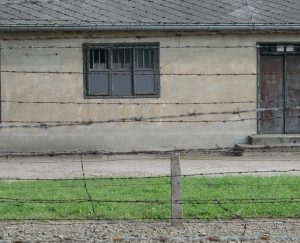
POW camp pixabay

Shantung Compound is Gilkey’s account of the endlessly frustrated attempts, by various camp leaders and elected committees and a few charismatic individuals, to enforce a fair allocation of the smallish rooms and dorm beds, to get everyone to do a fair share of work, to prevent stealing, to settle social disputes, to provide for the exceptional needs of the elderly, the frail, the young kids, the nursing mothers…

The overwhelming truth is that, facing the prospective dangers and daily extremities of camp life, nearly all of the internees didn’t “rise to the occasion” to protect the weak and to cooperate rationally for their own good and the common good.

Instead, this is what nearly all of the internees—most of them white, educated, Western—tended to do most of the time: they conspicuously looked out for themselves and their families, declined to do more than a modicum of work, refused to give up some of their “equal” share of food and housing to needier fellow inmates, shied away from volunteer leadership, declined to share the contents of relief parcels sent by their “own” governments, stole food and supplies whenever possible, refused to punish the egregious wrongdoers among them, and rationalized most of their uncharitable, uncooperative, and uncivil behavior in complex variations of religious and humanist moralities…

Mind you, this wasn’t humanity in a state of nature. There wasn’t any “. . . Nature, red in tooth and claw” stuff. The Japanese guards remained aloof from the prisoners’ largely autonomous camp administration, and the guards permitted black market trading with villagers outside the camp. The internees lived in dismal but not life-threatening conditions. They lived peaceably, often manifesting their shortcomings in a nominally genteel way. In a perverted sense, they were in a protected environment, and really didn’t worry much about anything except surviving in a tolerably impoverished condition as part of a generally homogeneous group.

They could have lived an Enlightenment fantasy in Shantung Compound. They could have established a coherent community with orderly cooperation, consensual leadership, and rational allocation of food, housing and civic niceties to appropriately satisfy the disparate needs of all.

But they didn’t.

Here endeth the lesson for today.


In 1990 Gilkey was interviewed by Joe Bessler-Northcutt for an article in the American Journal of Theology & Philosophy (2007, Vol 28, No. 1). Gilkey said: “…it began to dawn on me that our political problems…were really moral problems. I wasn’t right that there were only material problems and organizational problems—learning how to cook and organizing the kitchen and so forth—but that a community has a lot of other things going on. And that it was the moral, insofar as there was any reflection there, that holds the community together. You have got to have supplies, you have got to have organization, that I knew very well. But you have also got to have some kind of moral structure to the community or the supplies, and the organization are not going to get you anywhere. Now that’s the main theme of the book.”

*   *   *   *   *   *

Book review. Copyright © Richard Carl Subber 2017 All rights reserved.


Book review: Lord of the Flies

Never more relevant…

by William Golding

click here

 
Seeing far: Selected poems with 47 free verse and haiku poems,
and the rest of my poetry books are for sale on Amazon (paperback and Kindle)
and free in Kindle Unlimited, search Amazon for “Richard Carl Subber”
Your comments are welcome—tell me what you’re thinking.

 

*   *   *   *   *   *

Follow Rick on Facebook

Thoughtful book reviews by Rick Subber

Nothing Found

Book review: Forced Founders

Book review: Forced Founders

about the so-called “Founding Fathers”…


Book review:

Forced Founders:

Indians, Debtors, Slaves

& the Making of the

American Revolution in Virginia


by Woody Holton  

Williamsburg, VA: the Omohundro Institute of Early American History and Culture, 1999.

256 pages


Holton offers a backstory to the drive by Virginia’s elite political leaders to support the Declaration of Independence and the rebellion against England. He argues that Indians, slaves, merchants and small farmers, each in their own sphere, exerted influence on Washington, Jefferson and other Virginia leaders that helped to motivate their advocacy for independence.

Holton provides rich detail as he explores the obvious and not-so-obvious relationships of these interest groups, and as he describes the not wholly successful effort of the powerful landowners (in many cases, they were also land speculators) to achieve and expand their control of the factors of production: land, capital and labor.

Holton is at his most persuasive when he details circumstances in which the interests of the elites were more or less congruent with the interests of the generally disenfranchised but nevertheless potent subordinate classes who occupied their colonial world.

Forced Founders supports and enlarges our understanding that the so-called “Founding Fathers” were not a monolithic group motivated exclusively by patriotic fervor for independence.

Book review. Copyright © Richard Carl Subber 2016 All rights reserved.


Book review:

American Scripture:

Making the Declaration of Independence

…basically, it’s trash talk to King George

by Pauline Maier

click here

​-
many waters: more poems with 53 free verse poems,
and the rest of my poetry books are for sale on Amazon (paperback and Kindle)
and free in Kindle Unlimited, search Amazon for “Richard Carl Subber”


Follow Rick on Facebook

Thoughtful book reviews by Rick Subber

Nothing Found

Pin It on Pinterest