Book review: Six Plays by Henrik Ibsen

Book review: Six Plays by Henrik Ibsen

“Millions of women…”


Six Plays by Henrik Ibsen


by Henrik Ibsen (1828-1906)

Norwegian playwright, theater director, and poet

The Modern Library, New York  1957

Translated and with introduction by Eva Le Gallienne


In this volume, for your delectation:

A Doll’s House

Ghosts

An Enemy of the People

Rosmersholm

Hedda Gabler

The Master Builder


Ibsen is OK for beach reading whenever the sun disappears and you have to scooch down in your chair with a blanket and a hoodie to keep warm.

Of course it’s possible to argue with the notion that this is a collection of Ibsen’s best—for my taste, just about any half dozen of Ibsen’s plays is worth putting in the beach bag.

My favorite in Six Plays is “A Doll’s House.” It’s Ibsen’s stark, unforgiving play about men and women, with a dreadful undercurrent of desperation. Torvald Helmer offers only bland, devastating condescension to Nora, whose despair grows ever more public as she realizes that she has drowned herself in the domestic dead end of being Torvald’s “doll-wife.”

If you ache to bash Torvald and comfort Nora as you experience the pervasive and thinly veiled brutality in the Helmer household, then you, like me, must realize how much you wish it could be unimaginable in any way…but in vain…

Nora tells her husband that she had hoped he would take the blame for her transgression, and the disdainful Torvald rebukes her: “…one doesn’t sacrifice one’s honor for love’s sake.”

Nora replies with quiet thunder: “Millions of women have done so.”

Enfin, we understand how Nora could be too hurt to cry, and too happy to remain in a doll’s house…

*   *   *   *   *   *

Book review. Copyright © Richard Carl Subber 2018 All rights reserved.

​

Book review: Ethan Frome

not being satisfied with less…

by Edith Wharton

click here

​-

​My first name was rain: A dreamery of poems with 52 free verse and haiku poems,
and the rest of my poetry books are for sale on Amazon (paperback and Kindle)
and free in Kindle Unlimited, search Amazon for “Richard Carl Subber”

*   *   *   *   *   *

Follow Rick on Facebook

Thoughtful book reviews by Rick Subber

Nothing Found

Movie review: A Doll’s House

Movie review: A Doll’s House

“Millions of women…”


Movie review:

A Doll’s House (1973)


Starring Anthony Hopkins, Claire Bloom

Director: Patrick Garland

Based on Henrik Ibsen’s play, A Doll’s House (1879)

Claire Bloom won Best Actress award at 1973 Taormina International Film Festival


If you’re a fan of Ibsen’s stark, unforgiving play, you’ll love this film.

Both play and film have the same undercurrent of desperation. Hopkins as Torvald Helmer faultlessly offers bland, devastating condescension to Claire Bloom as Nora, whose despair grows ever more public as she realizes that she has drowned herself in the domestic dead end of being Torvald’s “doll-wife.”

If you ache, like me, to bash Torvald and comfort Nora as you watch the pervasive and thinly veiled brutality in the Helmer household, then you, like me, must realize how much you wish it could be unimaginable in any way…but in vain…

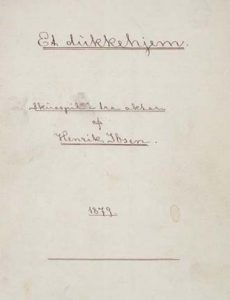
A Dolls House title page Ibsen Wikimedia

    Title page, A Doll’s House, Ibsen’s handwritten manuscript


Nora tells her husband that she had hoped he would take the blame for her transgression, and the disdainful Torvald rebukes her: “…one doesn’t sacrifice one’s honor for love’s sake.”

Nora replies with quiet thunder: “Millions of women have done so.”

Enfin, we understand how Nora could be too hurt to cry, and too happy to remain in a doll’s house…

*   *   *   *   *   *

Movie review. Copyright © Richard Carl Subber 2017 All rights reserved.


St. Ives, another look…

Less than meets the eye

by Robert Louis Stevenson

(a book review)

click here

–

Writing Rainbows: Poems for Grown-Ups with 59 free verse and haiku poems,
and the rest of my poetry books are for sale on Amazon (paperback and Kindle)
and free in Kindle Unlimited, search Amazon for “Richard Carl Subber”

*   *   *   *   *   *

Follow Rick on Facebook

Thoughtful book reviews by Rick Subber

Nothing Found

Movie review: “Ethan Frome”

The wanting never ends…


Movie review:

“Ethan Frome” (1993)


Liam Neeson, Patricia Arquette, Joan Allen

Director: John Madden

1 hr 39 mins

Based on the novel, Ethan Frome (1911), by Edith Wharton.


The breaking of a heart can take so long…

I watched the movie, then I read the book, then I watched the movie again (and again), it’s easier than reading the book again, but I’m going to do that too.

I think the book and the movie are interchangeable. Knowing the ending doesn’t reduce the dreadful intensity of this story that gets ever more sad from beginning to end.

Ethan Frome poster from IMDB

The deeply human love story breaks through the arid shell of real life—oh, so briefly…Ethan (Neeson) wants more, Mattie (Arquette) wants more, the viewer wants more…

Every other character in the story seems to, well, not necessarily “want” less, but to be all too righteously satisfied with less.

Except for a brief whirl of a crowded dance scene, there are no smiles on the faces of any of the other characters who live dried up lives, and disdain the spark of love and life in Ethan and Mattie.

Doubtless, the town folk see a pitiless moral lesson in the damaged life of Ethan Frome and the love he must keep stuffed inside him.

I see a man and a woman who share forbidden love, but don’t know what to do about it, and grotesquely fail to snuff it out.

*   *   *   *   *   *

Movie review. Copyright © Richard Carl Subber 2017 All rights reserved.

​
many waters: more poems with 53 free verse poems,
and the rest of my poetry books are for sale on Amazon (paperback and Kindle)
and free in Kindle Unlimited, search Amazon for “Richard Carl Subber”
​

Book review: The Sea Runners

…it informs, it does not soar…

by Ivan Doig

click here

*   *   *   *   *   *


Follow Rick on Facebook

Thoughtful book reviews by Rick Subber

Nothing Found

Poets talk about poetry

Poets talk about poetry

…no fractured, disjoint,

       inchoate grab-bags

               of words…


“A poem…begins as a lump in the throat, a sense of wrong,

                                 a homesickness, a lovesickness…” 


Robert Lee Frost  (1874-1963)

in his 1916 letter to Louis Untermeyer (1885-1977)


Frost and Untermeyer exchanged letters (imagine!) for almost 50 years. I’m pretty sure every single one of them involved more than 140 characters and spaces…think about it, when you’re actually scribbling, you don’t have to “write” a space…

There are, I guess, about a million or so ways, more or less, to define “poetry.” In 1827 Samuel Taylor Coleridge (1772-1834) offered his “homely definition” of poetry: “the right words in the right order.” Sometimes I think poetry is the manifestation of lust for the right words.

I have this lust in my heart.

I am a poet, a writer, a teacher, a moralist, a historian, and an unflinching student of human nature. Some things I’d rather not know, but I’m stuck with knowing them. I think a lot. I strive to express truth and give context—both rational and emotional—to reality.

I think words can be pictures, and lovely songs, and bodacious scents, and private flavors, and early morning caresses that wake each part of me, one at a time. I know some of those words, and, from time to time, I write some of them.

Here’s a final thought for consideration: Coleridge also advised (1832) that “…if every verse is not poetry, it [should be], at least, good sense.” That makes good sense to me. I have no tolerance for some poets’ work that is merely a fractured, disjoint, inchoate grab-bag of words. A largely random collection of words is not likely to be a poem. I like to read (and write) a beginning, and an end, and some really meaty sweetie stuff in the middle.

Coleridge’s 1827 definition of poetry is from Specimens of the Table Talk of the late Samuel Taylor Coleridge, written by Henry Nelson Coleridge and published in 1835.

Louis Untermeyer was an American poet, anthologist, critic, and editor. He was appointed the 14th Consultant in Poetry to the Library of Congress in 1961.


For example, read The Poetry of Robert Frost, available on Amazon

*   *   *   *   *   *

My poetry. Copyright © Richard Carl Subber 2017 All rights reserved.

​​
My first name was rain: A dreamery of poems with 52 free verse and haiku poems,
and the rest of my poetry books are for sale on Amazon (paperback and Kindle)
and free in Kindle Unlimited, search Amazon for “Richard Carl Subber”

​

Book review: Shantung Compound

They didn’t care much

      about each other…

by Langdon Gilkey

click here

*   *   *   *   *   *

Book review: The Bridges of Madison County

Book review: The Bridges of Madison County

Book review:

The Bridges of Madison County


by Robert James Waller (1939-2017)

New York: Warner Books Inc., 1992

171 pages


The Bridges of Madison County was notably popular when it was a new book. However, I’m aware that not everyone is a fan.

If you’re looking for highly stoked eroticism and high-rolling lives that throw off sparks when they touch, look elsewhere.

Frankly, for lots of tastes, here’s good advice: look elsewhere no matter what you’re looking for.

For me, Bridges documents the chance intersection of the putatively unremarkable lives of Francesca and Robert with all the heat and dazzle of slow-moving lava, without its destructive power. They come together, they permit each other to nourish their beautiful personae, and they generate a passion that consumes without burning.

Francesca and Robert come together too late in their lives, after unbreakable commitments have been made to other cherished persons who, regrettably, are not like themselves.

I am drawn to the unsounded depths of their love and their absolute, cascading, undeniable recognition of each other as the unforgettable objects of their burgeoning desire.

They understand that they must be content with the short lifetime of their dalliance. They honor their love by deeply understanding its nature, and by accepting the permanent separation that their unyielding integrity requires.

Robert whispers to Francesca: “…this kind of certainty comes only once…”

The Bridges of Madison County is a love song, a courtship, a delicate primer on yearning, a too brief opportunity to know how it feels to be in love like that.

Do yourself a favor, and give it a try.

*   *   *   *   *   *

  A poet is a “maker”

…and it doesn’t have to rhyme…

click here

Book review. Copyright © Richard Carl Subber 2017 All rights reserved.

–

​As with another eye: Poems of exactitude with 55 free verse and haiku poems,
and the rest of my poetry books are for sale on Amazon (paperback and Kindle)
and free in Kindle Unlimited, search Amazon for “Richard Carl Subber”


​

*   *   *   *   *   *

Follow Rick on Facebook

Thoughtful book reviews by Rick Subber

Nothing Found

Book review: Shantung Compound

Book review: Shantung Compound

They didn’t

     “rise to the occasion”…


Book review:

Shantung Compound:

The Story of Men and Women

   Under Pressure


by Langdon B. Gilkey (1919-2004)

Harper & Row, New York, 1966

242 pages


This is the most provocative book I’ve read in my adult life. 

It powerfully evokes a very civilized despair for the human social condition. It tells us that the Western notion of the social contract is a wistful, romantic notion. I think I said that in a nice way. Shantung Compound was a blunt, clarifying, transformative read for me. 

In Gilkey’s words, “This book is about the life of a civilian internment camp in North China during the war against Japan . . . Because internment-camp life seems to reveal more clearly than does ordinary experience the anatomy of man’s common social and moral problems and the bases of human communal existence, this book finally has been written.”

Gilkey was a 24-year-old American teacher in a Chinese university when World War II commenced. He and about 2,000 others, men, women, and children, mostly Europeans including academics, clergy and businessmen, were imprisoned for more than two years in relatively benign conditions in the Weihsien camp near Shantung. Their Japanese captors provided the bare minimum of food and coal, and told the inmates to run the camp inside the walls.

POW camp pixabay

Shantung Compound is Gilkey’s account of the endlessly frustrated attempts, by various camp leaders and elected committees and a few charismatic individuals, to enforce a fair allocation of the smallish rooms and dorm beds, to get everyone to do a fair share of work, to prevent stealing, to settle social disputes, to provide for the exceptional needs of the elderly, the frail, the young kids, the nursing mothers…

The overwhelming truth is that, facing the prospective dangers and daily extremities of camp life, nearly all of the internees didn’t “rise to the occasion” to protect the weak and to cooperate rationally for their own good and the common good.

Instead, this is what nearly all of the internees—most of them white, educated, Western—tended to do most of the time: they conspicuously looked out for themselves and their families, declined to do more than a modicum of work, refused to give up some of their “equal” share of food and housing to needier fellow inmates, shied away from volunteer leadership, declined to share the contents of relief parcels sent by their “own” governments, stole food and supplies whenever possible, refused to punish the egregious wrongdoers among them, and rationalized most of their uncharitable, uncooperative, and uncivil behavior in complex variations of religious and humanist moralities…

Mind you, this wasn’t humanity in a state of nature. There wasn’t any “. . . Nature, red in tooth and claw” stuff. The Japanese guards remained aloof from the prisoners’ largely autonomous camp administration, and the guards permitted black market trading with villagers outside the camp. The internees lived in dismal but not life-threatening conditions. They lived peaceably, often manifesting their shortcomings in a nominally genteel way. In a perverted sense, they were in a protected environment, and really didn’t worry much about anything except surviving in a tolerably impoverished condition as part of a generally homogeneous group.

They could have lived an Enlightenment fantasy in Shantung Compound. They could have established a coherent community with orderly cooperation, consensual leadership, and rational allocation of food, housing and civic niceties to appropriately satisfy the disparate needs of all.

But they didn’t.

Here endeth the lesson for today.


​In 1990 Gilkey was interviewed by Joe Bessler-Northcutt for an article in the American Journal of Theology & Philosophy (2007, Vol 28, No. 1). Gilkey said: “…it began to dawn on me that our political problems…were really moral problems. I wasn’t right that there were only material problems and organizational problems—learning how to cook and organizing the kitchen and so forth—but that a community has a lot of other things going on. And that it was the moral, insofar as there was any reflection there, that holds the community together. You have got to have supplies, you have got to have organization, that I knew very well. But you have also got to have some kind of moral structure to the community or the supplies, and the organization are not going to get you anywhere. Now that’s the main theme of the book.”

*   *   *   *   *   *

Book review. Copyright © Richard Carl Subber 2017 All rights reserved.


Book review: Lord of the Flies

Never more relevant…

by William Golding

click here

 
Seeing far: Selected poems with 47 free verse and haiku poems,
and the rest of my poetry books are for sale on Amazon (paperback and Kindle)
and free in Kindle Unlimited, search Amazon for “Richard Carl Subber”
​
​Your comments are welcome—tell me what you’re thinking.


*   *   *   *   *   *

Follow Rick on Facebook

Thoughtful book reviews by Rick Subber

Nothing Found

Pin It on Pinterest