Book review: An Anthology of the New England Poets

Book review: An Anthology of the New England Poets

“…a parcel of vain strivings…”


Book review:

An Anthology

   of the New England Poets:

    From Colonial Times

    to the Present Day


Edited by Louis Untermeyer, New York: Random House, 1948 


A hearty sampling of nearly 35 American poets, spanning 340 years. Louis Untermeyer is a first-class editor, offering rich biographical sketches of each poet.

For the beginning student of American poetry, this is a heady introduction. If you already know something about poetry, you can dive deep.

The big names are included, of course: Frost, Longfellow, Millay, Dickinson, Thoreau, Holmes, Whittier, Emerson.

The other selected poets offer a variety of voices and sensitivities and styles.

Untermeyer does first class service as editor, with a biography of each poet and a reference framework of his/her times. For my taste, the sketches of many of the poets were more informative and appealing than their works.

Untermeyer doesn’t presume to rate the poets in Anthology. He offers a well-informed understanding of the evolution and expression of poetry among New England writers.

Here’s a morsel:

“I am a parcel of vain strivings tied

      By a chance bond together,

   Dangling this way and that…”

From “I Am a Parcel of Vain Strivings Tied” by Henry David Thoreau (1817-1862), written in 1841

*   *   *   *   *   *

Book review. Copyright © Richard Carl Subber 2018 All rights reserved.

Writing Rainbows: Poems for Grown-Ups with 59 free verse and haiku poems,
and the rest of my poetry books are for sale on Amazon (paperback and Kindle)
and free in Kindle Unlimited, search Amazon for “Richard Carl Subber”
​​-

Forget about Buffy the Vampire Slayer

Dracula is a really scary book, really…

by Bram Stoker

click here

*   *   *   *   *   *

Follow Rick on Facebook

Thoughtful book reviews by Rick Subber

Nothing Found

The poetic art of Grace Butcher

The poetic art of Grace Butcher

Find an audience,

     and read out loud…


Grace Butcher’s poems

   beg to be read aloud.


They are narrative and artful. She writes about familiar sights and experiences, and infuses them with exceptional imagery and insight.

Indeed, “the best words in the best order.” (I’m sure Coleridge doesn’t mind being quoted endlessly…)

Butcher has a delicate touch as she strokes the fabulous effulgence of her imagination, and explores her sensitivities to life and people around her.

These are worth your time:

Child, House, World

Hiram Poetry Review Supplement No. 12, 1991


Deer in the Mall

Self-published by Grace Butcher

*   *   *   *   *   *


Book review. Copyright © Richard Carl Subber 2017 All rights reserved.


My first name was rain: A dreamery of poems with 53 free verse and haiku poems,
and the rest of my poetry books are for sale on Amazon (paperback and Kindle)
and free in Kindle Unlimited, search Amazon for “Richard Carl Subber”

*   *   *   *   *   *

Follow Rick on Facebook

Thoughtful book reviews by Rick Subber

Nothing Found

Poets talk about poetry

Poets talk about poetry

…no fractured, disjoint,

       inchoate grab-bags

               of words…


“A poem…begins as a lump in the throat, a sense of wrong,

                                 a homesickness, a lovesickness…” 


Robert Lee Frost  (1874-1963)

in his 1916 letter to Louis Untermeyer (1885-1977)


Frost and Untermeyer exchanged letters (imagine!) for almost 50 years. I’m pretty sure every single one of them involved more than 140 characters and spaces…think about it, when you’re actually scribbling, you don’t have to “write” a space…

There are, I guess, about a million or so ways, more or less, to define “poetry.” In 1827 Samuel Taylor Coleridge (1772-1834) offered his “homely definition” of poetry: “the right words in the right order.” Sometimes I think poetry is the manifestation of lust for the right words.

I have this lust in my heart.

I am a poet, a writer, a teacher, a moralist, a historian, and an unflinching student of human nature. Some things I’d rather not know, but I’m stuck with knowing them. I think a lot. I strive to express truth and give context—both rational and emotional—to reality.

I think words can be pictures, and lovely songs, and bodacious scents, and private flavors, and early morning caresses that wake each part of me, one at a time. I know some of those words, and, from time to time, I write some of them.

Here’s a final thought for consideration: Coleridge also advised (1832) that “…if every verse is not poetry, it [should be], at least, good sense.” That makes good sense to me. I have no tolerance for some poets’ work that is merely a fractured, disjoint, inchoate grab-bag of words. A largely random collection of words is not likely to be a poem. I like to read (and write) a beginning, and an end, and some really meaty sweetie stuff in the middle.

Coleridge’s 1827 definition of poetry is from Specimens of the Table Talk of the late Samuel Taylor Coleridge, written by Henry Nelson Coleridge and published in 1835.

Louis Untermeyer was an American poet, anthologist, critic, and editor. He was appointed the 14th Consultant in Poetry to the Library of Congress in 1961.


For example, read The Poetry of Robert Frost, available on Amazon

*   *   *   *   *   *

My poetry. Copyright © Richard Carl Subber 2017 All rights reserved.

​​
My first name was rain: A dreamery of poems with 52 free verse and haiku poems,
and the rest of my poetry books are for sale on Amazon (paperback and Kindle)
and free in Kindle Unlimited, search Amazon for “Richard Carl Subber”

Book review: Shantung Compound

They didn’t care much

      about each other…

by Langdon Gilkey

click here

*   *   *   *   *   *

A poet is a “maker”

A poet is a “maker”

No such thing as a “long poem”…


“Poem” has its etymological root in a Greek verb meaning “to make,” thus a poem is something made. A more detailed description of poetry has been elusive for more than a couple thousand years.

This is a somewhat bountiful book on this subject: Classic Writings on Poetry, edited by Dr. William Harmon.

From Harmon’s Introduction:

“…In none of [these] documents is poetry as such distinguished very crisply from prose…(1)

Poetry resists absolute definitions…Rhyme, for example, has been an incidental blemish of prose in many literatures, especially those of classical antiquity…in time, however, in the poetry of Europe, rhyme turned into an ornament so important that ‘rhyme’ itself virtually came to mean ‘poem’…”


Before that happened, “…during the Middle Ages…rhymed accentual verse was introduced for certain religious texts set to music, but rhyme was so alien to true poetry, according to many conservatives, that such texts were called ‘proses.’ “(2)

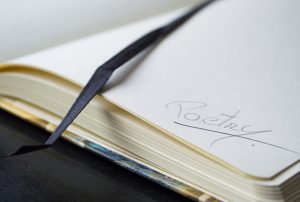
Notebook Pixabay

For the record: Harmon notes that an “old-fashioned” poem, or “verse,” like “Adeste Fideles,” does not rhyme either in Latin or in English.


I am fully intrigued by reflecting on the distinction between prose and poetry. To be sure, I’m not yet prepared to offer any compelling commentary on that point, except to say that I’m in complete agreement with Edgar Allan Poe in believing that brevity has something to do with it.

In his “The Poetic Principle,” Poe makes this view very clear:

“I hold that a long poem does not exist. I maintain that the phrase, ‘a long poem,’ is simply a flat contradiction in terms.

“I need scarcely observe that a poem deserves its title only inasmuch as it excites, by elevating the soul. The value of the poem is in the ratio of this elevating excitement…That degree of excitement which would entitle a poem to be so called at all, cannot be sustained throughout a composition of any great length. After the lapse of half an hour, at the very utmost, it flags—fails—a revulsion ensues—and then the poem is, in effect, and in fact, no longer such.”


It takes just about a minute to read this post.

‘nuff said.


(1) Harmon, p. xii

(2) Ibid., p. x

*   *   *   *   *   *

many waters: more poems with 53 free verse poems,
and the rest of my poetry books are for sale on Amazon (paperback and Kindle)
and free in Kindle Unlimited, search Amazon for “Richard Carl Subber”


Follow Rick on Facebook

Thoughtful book reviews by Rick Subber

Nothing Found

Book review: Grace Notes

Book review: Grace Notes

Book review:

Grace Notes


by Brian Doyle

Chicago, IL: ACTA Publications, 2011


You know, some of Brian Doyle’s prose, in this collection of his musings and essays, comes pretty close to my concept of poetry.

You ask why? Doyle is so particular, and so deft, in choosing the right words to frame his mood, his awareness, and his imagination in so many examples.

Try this excerpt from “Their Thin Bony Shoulders.” Doyle was invited to tell some stories and otherwise talk to nuns in their Benedictine monastery in Oregon. Among other subjects, he told them about “my mama.”

“And I stood there at the lectern, in that cavernous room in that lovely old monastery, with its cedared air like music in the nose, the extraordinary faces of the nuns held up to me in the twilight, and I tried to imagine or articulate or conceive a world without my mother in it, and I started to cry, and I could not stop.

Forty-nine years old, and still sobbing in front of nuns.

No one spoke.”

Don’t even try to pretend that your eyes aren’t a bit damp.


In Doyle’s Grace Notes, you can also take some time with “Advice to My Son,” “A Child is Not a Furniture,” “On Miraculousness,” and 33 other treats from his inquiring and incisive mind.


Book review: The Blithedale Romance

by Nathaniel Hawthorne, not his best…

click here


Book review. Copyright © Richard Carl Subber 2017 All rights reserved.

​-
many waters: more poems with 53 free verse poems,
and the rest of my poetry books are for sale on Amazon (paperback and Kindle)
and free in Kindle Unlimited, search Amazon for “Richard Carl Subber”
A new poem about the right thing…

A new poem about the right thing…

Think again

about doing the right thing

(a new poem)


Vanity


Is it too hard to do the right thing?

Is it right to do the hard thing?


We feel old passion to stand up

and stand fast,

   in our crystal rectitude,

      for the right thing.

We know it, we love it,

   it is a thriving joy,

      manifest in our minds

      and in our hearts.


The mighty do not marvel.

The minions are not moved.

Other multitudes will not make

a murmur to urge us

to dream of good works,

   they do not encourage yearning

   to do the public good that slights no man.


Our prospect is more vain striving,

   or the meaner choice:

   endorse a pale type of the right thing.


The hard work—

the imperative reach for some right portion—

is to make our halloo to a lesser incarnation

of this dream that will not live in other hearts.


March 11, 2016

You might think that desperate convulsions in the Republican presidential primary in the spring of 2016 could have been the wellspring of this poem. In fact, I wrote it reflectively, as a reminder to my idealistic self that commitment to the right thing is of paramount importance, and that acknowledgement of the realistic possibilities is an imperative precondition for effective action.

Striving for the unreachable is a vanity.

A wise person said: pick battles you can win.

*   *   *   *   *   *


My poetry. Copyright © Richard Carl Subber 2017 All rights reserved.

Above all: Poems of dawn and more with 74 free verse poems,
and the rest of my poetry books are for sale on Amazon (paperback and Kindle)
and free in Kindle Unlimited, search Amazon for “Richard Carl Subber”


Follow Rick on Facebook

Thoughtful book reviews by Rick Subber

Nothing Found

Pin It on Pinterest